Friday, 22 April 2011

A small house

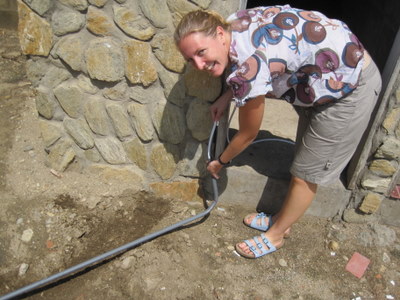
Last week Lydia and I decided to build a small wooden house.


Being us, and being Ghana this one has some unique design features:
  • The roof can open for easy maintenance...

  • The whole house is on stilts to keep out snakes...


  • There's a 5cm air gap around three sides of the top to allow air flow, but crucially horizontal rain can't get in. Should stay dry even in the worst of storms...

  • And the door can be locked open, locked closed, or swing both ways freely...

Someday we hope to have two big strong guard dogs living here. Until then...


(Left Senkelenke ('Thin person'), Right Obulobu (Ghaniain - 'Fat person')). 6 weeks old.

Love, Tim & Lyd

Friday, 8 April 2011

An interlude

To break up the essays, a progress update from the workshop here in Pram Pram.

Firstly, to show you around again:The beginning of a busy day  (video)

We now have 8 full time sewing staff, 3 batikers and 2 guards. True to the Global Mamas ethos of empowering women, the workers are mostly female, with just one tailor in the workshop.

Sewing is split into two teams, with the first two ladies to join, Charity and Eunice, running one each. They are well qualified for the roll, having both run a 2-4 person sewing spot in town before joining us. Their deputies, Phidelia and TT have 15 years sewing experience between them, TT is also our resident machine maintenance man, as well as being handy at fixing electrical items. Justina and Gifty are our new arrivals, filling the 'junior seamstress' rolls in each team. Both are from New Ningo rather than PramPram, the town a 5 minute drive East rather than West from us. These two turn up an hour early every day, we're not sure why but it certainly helps with productivity. The final team members Henrietta and Gladys are our 'Sewing Assistants', focusing on ironing and button making to assist the seamstresses.

              Phidelia (left) and Gladys beginning to make Pocket Wallets from our scraps
  
       Justina (left), Eunice and Henrietta (right) laying out a Sarong batik, ready for cutting
  
      Gifty just loves her new sewing machine. We now have seven with two more on the way.

  
On the batiking side, after the production of a three colour fabric named 'ornament drop' went wrong in Cape Coast, we've been handed the baton and taken over the manufacture here. It's a huge volume of work, the first request alone was for 500 yards. 

                                         Christy batiking in the shade of the trees
  
                   6 yards of 'City-Scape' sarong and 6 yards of 'Sunflowers' hangs to dry


On a very positive note Global Mamas has just refreshed the cost models for all production sites and, after much work, we're now the most cost efficient site for both batik and sewing that the organisation has. As a result we expect to be pushed hard over the coming months to make as much as possible at those nice new lower prices, which allow the NGO to expand significantly into the bulk wholesale market in the US. 

As for Lydia and I, Lyd is putting the finishing touches to the Access system which will manage this whole operation. It tracks all inventory, provides shopping lists for material purchasing, recommends prices and locations for purchasing, stores incoming orders and assigns work in daily or weekly buckets to our sewing and batiking teams. That's after she built the HR system, which we also use every day to keep things in order. Both are fully scalable for the large, 200 person workshop we someday hope to raise the funding to build.

                                                                  Our HR management system

I've been out and about purchasing twice a week, it's amazing how many raw materials are needed to keep a small workshop up and running. In my spare time I build cabinets and quality check the work coming from the sewing side of the operation.

                                                     The first of three cabinets...

 
All in all, the business is progressing nicely.

Tim x

Friday, 25 March 2011

Why is Africa poor? - Sub-Saharan culture

Sub-Saharan Africa is a rich mosaic of cultures, with more variety of beliefs and practices than can be seen on any other continent in the world. From the Wolof and Pulaar farmers of Senegal in the West to the traditional nomadic tribesmen of Somalia on the East, native customs have been blended with imported religions to weave a real tapestry of life across the land.


So how do these cultural beliefs influence wealth?


We begin with a look at the purpose of the culture in this region. An oxymoron perhaps, culture is not designed, but the collection of historical events, the memories of acts and deeds that grow to form a culture do not do so at random, and like evolution the ‘cultural norms’ that work best for the people practicing them become more accepted than those which do not.  A culture grows to ‘fit’ it’s community.


Cultural norms play a large part in family life in the region. Families are traditionally large, 2 children is considered unusually small (or very modern), while broods of 10 or more are not unheard of. The sharing of items and food is a given, passing a meal table while food is being served will result in the hale "you are invited" whether you are a member of the family or not. Likewise if your bicycle is not in use, and a brother or neighbor wishes to borrow it, they will, and you will think it normal.


Where sub-Saharan Africa differs notably to the west is that this sharing is extended to money. When an adult finishes a hard month’s work and has a little excess money, he will be put upon by poorer members of the extended family to share what remains. Considered ‘begging’ and somewhat shameful in the west, here it is not only normal, but the recipient of the money will not even show gratitude. Culturally the ‘funding’ of friends and family is considered an honour (although it is not optional), and the funder builds status within the community. It is therefore he, and not the recipient of the money who should be grateful.


Historically this cultural norm made sense, everyone in the community was provided for, wealth  travelled effectively down the poverty line, and those who could provide more sacrificed potential material gains for the respect of their peers and elders.


In modern times this cultural sharing of both assets and cash has many consequences on society. ‘Hording’ cash (read also, saving) is frowned upon, but the wary African no longer wishes to give away everything he has left over. Buying plots of land and then building, one wall at a time over a period of years is one way to get around the issue, and half built housing shells litter the countryside of Ghana. They will be completed slowly as each pay cheque comes in, or left to rot if the owner falls on hard times.


On a smaller scale our caretaker bought a battered and broken old taxi, and, despite having two children in school, spends any spare money he has repairing it so that one day he can put it on the road to earn extra income. As school fees are due, or hospital bills come in, an advance is required from us to help the situation, but crucially there is never any spare money to be shared, nor an appearance of wealth to prompt the request from peers.


How does this all affect national wealth? The inability of individuals to amass even a small amount of cash heavily stifles the creation of anything requiring investment. For a country where a quarter of the population is entrepreneurs, this is a real waste of burgeoning natural talent. On an individual level there are welders working as farm labourers for want of a welding torch and table, and seamstresses working in fish factories because they cannot save up for a sewing machine. Likewise investment in others’ businesses is very rare. A little upfront cash in a ‘Wagashi’ (delicious fried cheese) business to boost the heard, and the owner and investors would soon see returns, but as it is no one has the cash, so the food remains hard to find and sells out quickly.


Jealousy is the undesirable counterpart to the story above. Unlike in the west, where the enrichment of friends of family may be met with a little envy, but is otherwise considered praiseworthy, individual gains can be the subject of personal jealousy in sub-Saharan culture. The Fanti people of southern Ghana have accepted this cultural ‘trait’ to such an extent that they built a large statue of a crab in the centre of their capital city Cape Coast. On asking for the meaning of the crab the people will laugh and tell you ‘it represents our culture: when crabs are in a bucket they climb all over each other to get out, and when one is nearly out the others will pull him back in again’. At least they’re open about it.


Two examples from our time here back this one up. Our caretaker, who lost both parents aged five was raised by an aunt. His childhood and teenage years were spent on a farm, and having finished Junior High School aged 16, he was keen to go to agricultural college to further his understanding of farming. He was not asking for money, the school was not expensive and he would pay his way, but his aunt stopped him. He was needed at home, end of story. With no college education Teye continued to labour on the farm for many years before leaving the house, doing odd-jobs for a friend for some time, and finally becoming our caretaker. With a little more freedom early on he could have land and crops of his own by now, giving his own finances and the economy that little boost in the right direction.


The second example, also involving a jealous aunt, is about an excellent male batiker from the Accra region. Whilst receiving just 100 GHC per month (£40) this man came to be known by our director, and was offered a well paid position with Global Mamas. Again the aunt stepped in and stopped the move, which could have been the beginning of an exciting career for the young man. He continues to work for his aunt to this day.


Two final cultural areas which also impact wealth generation in the region:


The first harks back to the family, this time the huge innate respect for elders. The generations above you must be obeyed, whether it is your mother or grandfather at home, or an elderly man in the street, failure to obey will meet swift reproach. Again this is justified through evolution, the elders have more experience in life and should be obeyed instinctively. However this is a significant natural barrier to the western style ‘merit based’ staffing structure of a business. It is very difficult for a thirty five year old team leader to give a fifty year old in their team instructions, let alone hold them to account for poor performance. Our two resident elders here in PramPram refuse to do the cleaning in the morning, despite it being a shared task. The inability of a local to hire in ‘senior’ talent to her organisation without risking insubordination does not help the effectiveness of her business, and consequently reduces profit.


The second is language. While North America has one common language, and in South America Spanish is almost universally understood, in Ghana alone there are 7 ‘major’ languages, and over 100 dialects. There are 30 countries in the sub-Saharan band of Africa, each with this patchwork of tribal languages. Lack of easy communication with ones neighbours results in difficulty trading and less efficient markets, which again leads to an overall reduction in capital.


Sub-Saharan culture is exceptionally well designed for survival in a harsh and unpredictable environment. It is very fair from an income perspective, where respect is generated not by what you have, but by whom you have helped. Elders are obeyed instinctively in times of trouble, and the poor do not go hungry.


But this is a subsistence living, and in the modern world these cultural norms hamper the development of a middle class, and a healthy national economy. The culture is evolving, predictably in a western direction, and slowly, with the loss of traditional customs and beliefs, comes that much sought after commodity for which the heaviest of prices is often paid; wealth.

Friday, 11 March 2011

Why is Africa poor? - History of Ghana

With a per-capita income 50 percent less than that of the next poorest region, sub-Saharan Africa is the poorest place on earth, by some margin. But why? Over the next few weeks this blog will turn from a photo intensive look at modern Ghana to a philosophical debate about the evolution of wealth in this country, and the region as a whole.

The general consensus is that sub-Sarahan Africa is poor because it has been mis-managed, by it’s leaders, and by those providing big-money aid from abroad. We will examine these issues, but also look at how the culture of the people here impacts their wealth, as well as the impact of religion - both local beliefs and those imported from abroad.

But first, the question ‘why is Africa poor today’ can be answered very simply. Because it was poor yesterday. Change takes time, and we will open our discussions with a look at the history of Ghana and how the colonial period set it up very badly for the 20th century.

Why is Africa poor? - History of Ghana

The ancestors of today’s Ghanaian residents are said to have arrived in the 9th or 10th century, forming what we call today the medieval ‘West African Ghana Empire’. The empire was named after its then emperor, ‘the Ghana’. It is this empire which first became known to Europe and Arabia.

The Portuguese were the first Europeans to arrive in 1471. By then the area was known as the Gold coast, and the Portuguese came to trade in gold, ivory and pepper. Having held the area by force against other European nations for over a century, by 1598 the Dutch had joined the Portuguese and also begun trading in the region.

By the mid 17th century other European nations had arrived and the coastline was peppered with forts, which were regularly attacked, captured, sold and exchanged. The area developed the highest concentration of European military architecture outside of Europe. Throughout this period alliances were frequently made with local tribes, notably the Ashanti and the Fanti peoples, whom were often drawn into the battles, or attacked by rival European factions.

In the late seventeenth century the Gold Coast shifted from being a gold exporting economy to being a slave exporting economy. In exchange for guns and other imported goods, the local tribes were encouraged to make war further afield and bring back slaves to sell to the Europeans.


(The triangular slave trade. European ships laden with slaves were shipped from Africa to America, where the slaves worked to harvest the cash crops grown on the vast open plains. These crops were shipped back to Europe for consumption, and the ships then set sail for Africa with the goods required to purchase the slaves for the next run.)

Beginning in 1850, the coastal regions increasingly came under control of the governor of the British fortresses. British authorities adopted a system of indirect rule for colonial administration, wherein traditional chiefs maintained power but took instructions from their European supervisors. Indirect rule was cost-effective, minimized local opposition to European rule, and guaranteed law and order.

By the mid 20th century, as with most African countries, nationalism was on the rise and Ghana looked to be free of it’s colonial noose. The social and economic developments seen in the region throughout the  20th century were thought to be possible without British colonial masters, and on March 6, 1957 the former British colony of the Gold Coast became the independent state of Ghana, and the British withdrew.

With the formation of the National Assembly, and the beginning of self rule, our brief history of Ghana ends. What happened next will be discussed in a future piece on ‘Police, Government and Corruption’.

The past five centuries of history of sub-Saharan Africa are a tale of manipulation, exploitation, and constant warfare under the direction of Europeans. While the West went through the industrial revolution and grew rich on mass production and cheap imports, the Gold coast region was repeatedly torn apart and the pieces controlled in a giant game of ‘Risk’ by European masters.

Why is Africa poor today?  Because it was poor yesterday. But the debate does not end there, next week we will look at how culture plays a significant role on individuals’ wealth in the region.

- My thanks to the authors of the ‘History of Ghana’ page on Wikipedia, without whom this would have been a short and rather fact free blog entry.

Monday, 28 February 2011

The Generator

Without a generator, the frequent 'light off' as they say in Ghana will significantly hamper the productivity of your operation. Should you wish to connect a generator, here's how...
 
Begin by following the instructions on the machine itself. 'Motor locks' which hold rotating parts steady during transport will need removing, the axles and wheels will need attaching, and the battery will need mounting and connecting...


Now find an appropriate location for the generator. If it is small you will want to keep it inside and move it outside when in use. The one in this example if 6kW and is best located in a permanent outhouse with good ventilation. You will also need to consider the size of the cable connecting the generator to the primary circuit breaker. At 25A - single phase - this generator needs a '4mm by 3' wire. As you route the line from the outhouse to the main electrical hub be sure to protect it with pipe as it passes underground...


Home made ladders can be dangerous. Rope in a strong young lad like Teye to hold it steady for you while you feed that cable over the rafters...


Now for the fun part. You'll need to determine the number of live feeds required by your site. We receive 3 phases, but each is used to power a different part of the building, so a junction box is required. Drill through the wall to bring the generator's cable inside and feed it into the junction box. Unlike in the UK, '1 to 3' connectors don't exist and a junction box is actually just an empty casing with room for a lot of electrical tape! With 25A at hand, do the decent thing and buy a series of 1 to 1 brass lugs and use them to split the live wire into 3.

                                    (thanks to Tim's dad for his advice on this part)
 
Below the junction box you'll see the large transfer switch, already wired to the mains (normally this would need to be installed, but we already have one. It is used as a main 'on-off' for the house.) Route the neutral and the (now 3) live wires into the relevant brass connections in the bottom of the transfer switch. TAKE CARE - those black cables coming out the top of the box are the live feed from the main external power cables and can't be shut off. Don't touch them!

With everything in order inside the house you're nearly done. One last challenge. Swapping the live and neutral wires on an AC appliance doesn't normally matter (the current is after all 'alternating' 50 times a second), but get it wrong on a generator and every fuse and circuit breaker in the house becomes useless. That's not good for your workforce's health. Use the wiring schematic for the generator to ensure you know which outlet it will use for the live feed, and wire the round, waterproof plug appropriately...


                                                                 Plug it in...

                                                               Start it up...
 
And you're away! No more 'light off' to slow down those sewing machines :o)
Lyd x

Friday, 18 February 2011

One month on...

We have been open now for 1 month and in that time we have welcomed 4 new members to the Prampram Workshop Team:

                                      TT – Sewing machine mechanic and tailor.

                                 Phildela – Seamstress (and also our amazing cook).

                                                            Faustina - Batiker.


                                                Henrietta – Seamstress Assistant.


                    We have also produced over 200yds of batik cloth and 150 sewn items:


                                                And Rosemary is now crawling!

Last week we received our first official order from the US so we are working hard to get these products ready to be shipped from Accra on the 11th March.
  
  
Outside of the workshop, Tim has started playing polo on Friday evenings with our friend Bob.  I think he is a natural!!


We have also taken up scrabble and can be found most evenings battling it out across the board!

 T&L xxx

Friday, 4 February 2011

Want to help?

We've had enquires from a couple of readers now about how they could contribute directly to the development of our site here in PramPram. Making the logical assumption that if two people are thinking that way, you must, infact, all be about to ask the very same question, we've bowed to your request and laid out your options below.

A starter for 10, or in this case 20, these sturdy fans are the workhorse of our central ventilation system. Proven to reduce sweat by 300g/hr nothing says you care like Binatone’s five bladed ‘silent wonder'.

 
                                        Binatone variable speed, rotating fan (£20)

Feeling macho? Want to buy steel? These Ghanaian built propane tanks can take up to 34bar of highly explosive propane fuel with only a minimal chance of exploding. Thankfully they also hold LPG, which is good because it’s the only fuel you can buy out here. It’s also not as dangerous.

                                                  14.5kg LPG tank (£30) 


Prefer wood? Our local carpenter is superb and hand crafts these tables for batiking with little more than a chisel and sandpaper. They’re vital to the operation, and in use 8hrs a day.
Handmade batik table (£45), Charles awaits your order – although he will be a little late with delivery.


From outside to in, cutting tables need an excellent finish. Planed, varnished, sanded and varnished again, this beautiful redwood frame is fitted with a 6ft by 4ft plywood centre for a perfectly flat finish. A table that wouldn’t look out of place in John Lewis is yours for just £55.

                                             Handmade cutting table (£55)


Want to cut to the chase? We can’t sew without sewing machines. These are our most used and most valued assets on site, and are the critical milestones to expansion. Juki’s industrial sewing machine, with separate motor, isn’t cheap, but then we’re not planning on closing any time soon…
   Industrial sewing machine, arrives at the operation with an additional smiling seamstress (£190)


For every 5 sewing machines we need one knitting machine. With your foot down, these top end machines knit at 6,000 loops / minute, and are vital for finishing the inside seams on all dresses, shirts and T-shirts. (Turn the bottom side of your T-shirt or shirt inside out and look at the complex thread holding the front piece of material to the back – this is knitting thread from a machine like this one).

                                       Pricey, but still excellent value at £215
    
Want to go the whole hog? Our 16ft by 33ft outdoor shelter needs a new roof, the old one was looking a little worn last week. We’re half way there, now for the thatch.

                              £1200, comes with a sheepish but very grateful caretaker


This post is meant more as a tongue in cheek guide to what we’ve been buying than as a serious fund raising effort. However if you are keen to donate please do drop us an email at timoricho@hotmail.com. Our ladies will be very grateful.

All our love,

Tim & Lyd xxx