Tuesday, 27 September 2011

Accra 10Km

On Sunday Tim and I took part in the 10K race of the Accra International Marathon along with 6 friends. 'Took part' is a generous term for Tim, who drove support car from the start line to the finish line, but like he kept saying, 'someone had to do it'.

We got up at 4.30am to make sure we arrived at the start line in plenty of time for the 6.30am start.  As we arrived the sun was starting to rise. 


At 6.30 we were all called together by the race organiser,  the announcement went something like this:

"Welcome all... Now this is a running only race, there is to be no walking"

"NOOOO!"... cried the team of donut lovers in the crowd, "We were told we could walk it!".

"And also, the race is delayed to 7am"

An interesting introduction for an 'international' marathon, excited and burning nervous energy they delay was not ideal.  Of course it was too much to expect that something in Ghana would actually start on time!


By 7am it was starting to get hot as we lined up on the start line.


I couldn't help but notice the footwear of the girl standing next me.

"OK the race is about to begin" cries the race organiser. "Now we have decided this will be a walking only race"
  
WHAAAAAATTTTTTTT!!!!!! Uproar for about 30 seconds.
  
"OK! we have decided this will be an walking and a running race, some will walk and some will run".
   
Well I'm glad we cleared that up.
   
Soon enough the race was underway.  


It was hilly and hot.  Some of the race was on tarmac roads, the rest was on potholed dirt roads, which was a nightmare for the wheelchair racers.
The last 5 km was along the side of a busy road where it was necessary to keep an eye on the large number of tro-tros that regularly pulled in just in front of you!  It was hard work but I made it in 1hr2mins J  The girl in the flip flops beat me!


As an après run treat we went to a hotel for breakfast and spent the day hanging out by the pool with our friends.  It was a good day but I think it will be a while before I run for an hour in the Ghanaian heat again!


Love Tim and Lyd x

Friday, 26 August 2011

Back in Ghana

We have been back in Ghana for 2 weeks now.  I have been snapping photos with my new camera.  Here are a few of my favourites;

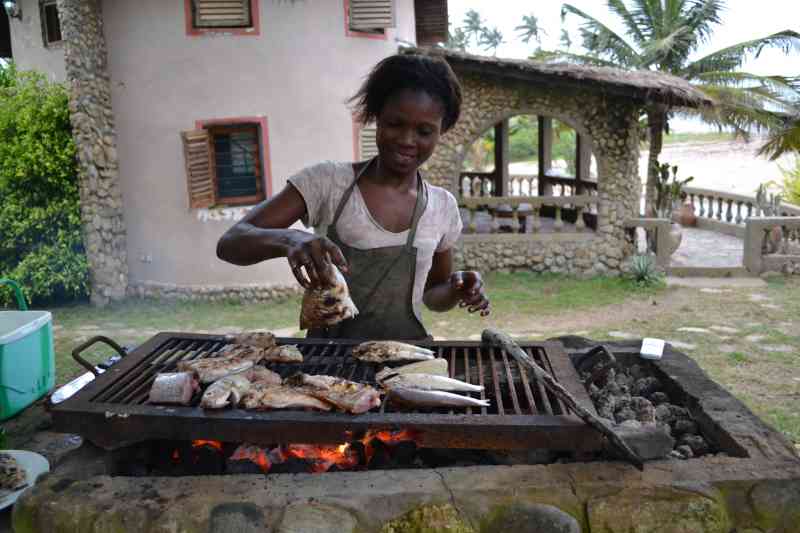
Last Monday, after work, we had a BBQ with all our workers.  They love to pose for the camera.


Christy did most of the cooking, whilst Be prepared the peppe – a blend of onion, tomato, and green and red chillies – spicy!


Obu and Senke are turning into the scary guard dogs that we hoped they would become;


Every evening we take the dogs for a walk along the beach.  I love this part of the day.  We rarely see anyone else on the beach that stretches for miles.  

Last Sunday our boss, Renae, and her family came to visit for the day.  This is her 2 year old son, Ben;
         
We all had a marvellous day, hanging out on the beach, kayaking in the sea and eating BBQ-ed burgers. 


Tim even took the dogs for a ride in the Kayak!


Some local boys performed some acrobatics for us on the beach;


This week, the biggest festival of the year is taking place in Prampram.  Homowo, is the festival to punish hunger.   Everyone in the town cooks large bowls of palm nut soup with fish or goat meat and invites their friends and family to dine with them.  This ensures that everyone in the town gets food and hence does not go hungry.

We were invited to join our friends Isaac and Helen, who own the bar which we visit regularly.  The food was delicious.  The street was packed with people whilst music was blasted from massive speakers.  A procession of carnival floats drove up and down the street.  These ‘floats’ consisted of  taxis with women sitting on the bonnet, roof and hanging from the window, whilst drinking liquor straight from the bottle!

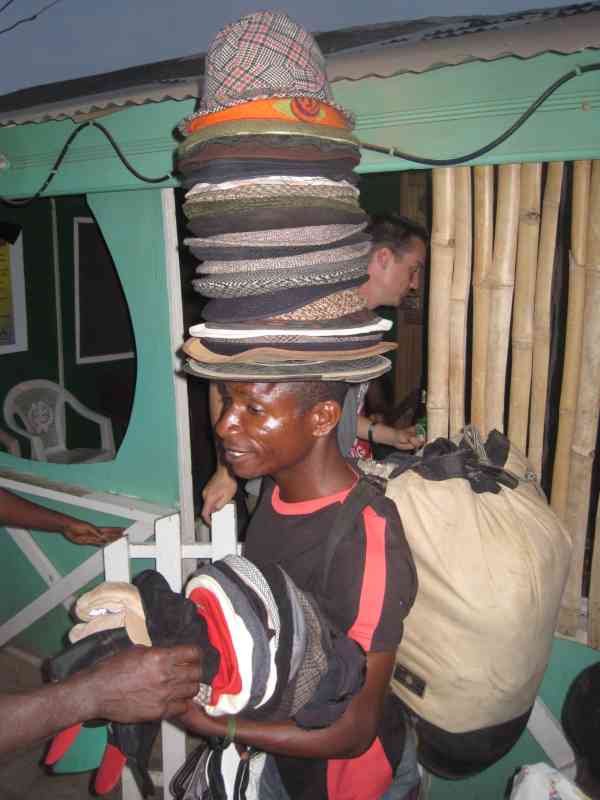
This man was selling hats at the festival!

On Saturday, as part of this festival we are going to watch “Miss Prampram”; the annual beauty pageant.  I will be sure to share some photos of this with you J


Lyd xx

Friday, 22 July 2011

Ghanaian Wedding

The wedding we attended last weekend led to our most embarrassing moment since arriving. It was also the most exciting day of the year.

14 days to go
Whilst attending an ‘adoring’ for a local newborn baby, Lydia, Amy (Lydia’s sister) and I are invited by a local seamstress to attend her wedding ceremony in two weeks time.
10 days to go
The three of us purchase cloth and take it to a local seamstress (actually the bride to be) and a local tailor to be made into ‘Ghanaian wedding attire’ suitable for the occasion.


9.30am morning of the wedding
To our delight it’s a slightly overcast day – the sweating will be kept to a minimum. On time, the three of us turn up to the church looking dapper.


The church, (the Dangme East, Evangelical Baptist Church) is actually one of two school classrooms, very long and thin with perhaps 200 chairs set up for the ceremony. Blue and Purple fabric hang in drapes from the ceiling, and a ‘floating’ archway of balloons sits as a central feature where the bride and groom will stand. It looks just like a wedding venue would look in England, except that it’s deserted. A lone pastor approaches us and explains that things are running late. We should come back in two hours.


We get in the car and go home.


11.30am
Bingo, other people. The same pastor guides us inside and we sit down to watch the preparations continue. There are about twenty guests so far.


11.45am
‘The Angelic Singers’ with their accompaniment begin to warm up just as the amp arrives and is plugged into the six enormous speakers. True to form the speakers are ‘blown out’ (broken) but turned up to full volume anyway. It’s frustrating because warming up the singers were actually quite good. The noise is almost unbearable.


12.00pm
In a somewhat casual beginning, the pastor welcomes the (still relatively small) congregation, and we begin to pray for the couple with the Angelic Singers in the ‘background’. Praying is taken very seriously here, and after a short introduction from the pastor the prayers are said individually, heads bowed, speaking with fire and passion and really willing god to look after the couple to be. The congregation grows.


12.30pm
The bride arrives and, just as at home, walks down the aisle to much admiration from the guests. She greets her husband to be and they sit under the arch at the front of the church. The pastor introduces the special guests at the wedding, including a surprise welcome to ‘Mr and Mrs Addison’ – which turns out to be us. Being a ‘special guest’ at a Ghanaian event is never as innocent as it sounds, as we were to find out later. 


The hymns begin. 


1.00pm
The vows are said, with much cheering and whooping from the guests after each section. The pastor is dismayed as this ‘serious’ section of the ceremony is repeatedly interrupted, but the congregation won’t be quiet and the ushers are positively encouraging the noise. People continually dance down to the front, round the couple and back to their seats. Everyone is on their feet cheering and the band can’t resist striking up. The couple love it, and before long they are formally married.
1.30pm
After another hymn and a collection for the church, a pastor steps forward with a large plastic bucket, and over the background music states that he wants 20 people to come forward and put 100,000 cedis (10 cedis in new money) in the collection for the new couple. 


This is awkward.


A few people (perhaps 5) go up straight away. The pastor keeps talking as they return to their seats. Slowly one or two more make their way forward, deposit the 10 cedis and return. Two or three minutes have now passed, and we’re only at about 10 deposits. 10 cedis is a lot of money for the average Ghanaian, even one with a good job. The pastor continues to talk about the couple’s small children, the cost of the wedding and the money they need for a house.


This is really awkward.


Lyd, Amy and I had planned to give a 45 cedi gift between us, in an envelope, with a card. Even writing this number down knowing that you’re reading it makes me uncomfortable. Standing up in a wedding, marching down the aisle as the only white people and proudly displaying to everyone “we’re rich, we can afford this” would be horrific. So we sit tight, still planning to give the money privately at the end.


After five minutes the money still was not raised, and an usher came forward, took the bowl and replaced it with a new one.


“Five cedis, everyone who can give five cedis come forward now”. Dear God no. This time more people stand up, parade down to the front, deposit the money and sit. Again there are five minutes of songs, with the pastor laying on the emotional blackmail, and one at a time more people make their way to the front.


The usher reappears, with another empty bowl. It's clear he's going all the way. “Two or one cedi”. Just about everyone in the congregation has now given something. We sit there, shame faced, feeling eyes burn into the back of our heads. We can’t stand up now and give two cedis, we’d look ridiculously tight. Half of our workforce from the sewing centre are here, and we’re horribly embarrassed. 


Finally the bowls disappear and we crack on with another hymn. 


2.30pm
“The first dance” announces the pastor. Unexpectedly soon, we’re still mid ceremony. But there’s a catch. “Anyone who wants to dance with the couple must pay 5 cedis”. It’s never going to end.


3.00pm
The ceremony finishes and we pile outside for photographs. Lyd, Amy and I are starving, we’ve not had lunch and we try to sneak off quickly for some yam. Too late, caught in the act by the bride we’re pulled into the (second) wedding photograph with the lucky couple. Well, we are distinguished guests.


3.15pm
After our sneaky bite to eat we return to the venue expecting to stand around chatting while the photos finish, but they’ve all been taken, and everyone’s back in the church sitting down. 


Round 2.


A sermon from the ‘guest’ pastor from Tema is the lead up to some serious praying for the couple from the congregation. 


Next ‘all the single people’ (read single ladies, there were only about 10 men in the church) are invited to stand up, parade up to the front, round the lectern and back to their seats, in the hope of finding a partner. The music picks up and, to much cheering and encouragement, the ladies line up and bop down the aisle, African style, with their bums shaking. Everyone is smiling. The ladies return to their seats.


“Mr and Mrs. Addison, you are invited to come forward and dance”. 


We’re stone cold sober. We’ve barely got over the morning’s ‘fundraising’. And now we’re going to dance for 200 Ghanaians.  It’s moments like this you never forget.


Not wanting to let our countrymen down, Lyd and I lead the charge up the aisle with a slightly reluctant Amy following close behind. As the music begins we swing our hips, put our hands in the air and give it everything we’ve got. Why not; they seem to love it. For the first time in my life I understand what it must be like to perform at a concert, I could get a taste for this. It’s a long song, and we’re soon joined by every member of the Global Mamas team at the wedding, ‘looking out’ for their bosses. Soon enough, we return to our seats.


A final round of fundraising, paying 1 cedi to pop one of the few hundred balloons in the floating arch begins, and the guests, slowly at first, begin to make their way out of the church. It seems a little rude, the bride and groom are right there at the front looking over the congregation and people are just leaving. After 15 minutes we join them outside, drop off our present and mingle in the fresh air.


5pm
Assuming it’s over we head for the car, but are told that as special guests we’ve been invited to a sit-down meal at the couple’s uncle’s house. A short ride through PramPram and we arrive at a house that would give a Californian mansion a run for it’s money. It’s a lovely place with a huge flat-screen TV, high ceilings and a sofa that could easily seat 30.
After a tasty rice and chicken we say our thanks to the bride and groom, and to our team for rescuing us, and retreat to the car.


What a day.
Love Tim, Lyd and Amy x

Thursday, 23 June 2011

Product lineup

With the end of our first year in Ghana approaching we thought we'd give you a picture of the products now made here in PramPram.

From an initial lineup of four, the site is now fully operational on twenty sewn items, in over thirty batik patterns.

Our range of bags is extensive, we produce only the fastest moving lines or those with one-off bulk orders. Our patchwork range allows us to use up even the smallest of off-cuts, and with the global shortage of cotton pushing up 'calico' prices, this recycling is a vital part of the Global Mamas business model.
Top left 'Large tote bag' (Box turtle, lime), Top right 'Large tote bag' (Raindrops, bronze), Centre 'Small tote bag' (Ornament drop lime), Right middle 'Crawling shoes', Middle left two 'Patchwork wallets' (Patchwork), Bottom left 'Passport Explorer Bag' (Patchwork)


The center piece below, the 'Urban explorer bag' is one of the best selling products in the catalog. Made from six overlapping assorted batik patterns and adorned with buttons and pockets it's a real eye catcher and sells well both in the US and the Ghana store. The bag can be made from batik off-cuts or from wax-print (high quality printed fabric made here in Ghana) scraps. The wax print production is about to come in-house at Pram Pram and we're just now negotiating a price for the off-cut bundles from the main supplier of wax print in Ghana.
Top left two 'Pocket Wallets' (Patchwork), Centre 'Urban explorer bag' (Patchwork), Top right 'Button basket' (Roses, wine), Centre bottom right 'Set of three stackable bins' (Oranges & Lemons)


Dresses are often intricate, and unlike the bags, making them exactly the right size is critical. Initially they were kept away from us ('the new guys'), but our cost prices proved irresistible. We now have two in the lineup and are looking for a third.
 Left 'Ruffle Dress' (Sunburst, Bronze), Right 'A-line dress' (Blocks, Wine)


Aprons, sarongs, varying small bags, pot holders and skirts make up the remainder of our line up. Most component parts for the items are sourced here in Ghana, although materials like heat proof fabric and high quality zips are shipped in from the US. In total we have over two hundred component parts that go into our  range of items, keeping inventory of them all can be a real challenge!
 Left hanging together two Aprons (Big fish, green and Flower patch, pink). Top centre two 'Glasses cases' patchwork. Top right 'Pot Holder' (Big fish, red). Bottom centre 'A-line skirt' (Ornament drop, lime)


We're also now fully up and running for volunteers with five beds in operation in the volunteer chalet. Looking at the schedule of folks coming in from the US, we're in for a busy Summer.

Here is Rachel (Left) and Morgan model a number of the Pram Pram items, and Lyd in the brand new 'Retro dress' hot off the sewing machines this morning. If this new line meets head office approval we'll go into production for export.

Love, Tim & Lyd x

Friday, 10 June 2011

Photos

To follow Tim’s pages of text, here are some nature photos that I have taken in the last few weeks:

From our garden/home:


                        A flower which lives for one day, then dies when the night comes


                   An amazingly bright pink flower adds colour to the dry, parched garden


                                                                   An insect


                                       The first pieces of okra that grew on our farm


                             Flowers growing over the wall from our neighbour's garden

       One of the hundreds of lizard poos that stick to the walls of our office and home (sorry!)


 From a recent trip to the Ghana-Togo border:

                                                          A coffee bean tree

                                                                A tree fungus

                         The hottest chilli that is grown in Ghana.  It is less than 1cm long.


                                                                  A beetle

                                                           A half eaten leaf

                                                           Another tree fungus

And finally, here are our scary guard dogs; 

                                                              Senke & Obu 

Lyd x

Friday, 27 May 2011

Why is Africa poor? - Corruption

According to the African Union, in excess of $140 billion is stolen from the African continent every year by it's leaders. This final essay will look in detail at corruption; understanding the definition, the causes and the severe consequences of this destructive practice.


What is corruption?

"Corruption, while being tied particularly to the act of bribery, is a general term covering the misuse of authority as a result of considerations of personal gain, which need not be monetary." David Bayley (1966: 720)


"Corruption is the diversion of public resources to nonpublic purposes." Herbert Werlin (1973: 73)


"Corruption is the outright theft, embezzlement of funds or other appropriation of state property, nepotism and the granting of favours to personal acquaintances, and the abuse of public authority and position to exact payments and privileges."(Harsch 1993: 33)


It is important to distinguish between political and bureaucratic corruption. While the latter involves efforts by civil servants to enrich themselves through illegal means, the former is used by political parties to win elections or take control of the state. Political corruption usually includes activities such as vote-rigging, registration of unqualified, dead, or non-existent voters, purchase and sale of votes, and the falsification of election results (Goodman 1990). Political corruption is not defined by the opening quotes above, nor is it the focus of this essay. Instead we will focus on bureaucratic corruption.


Corruption is measured by Transparency international who produce the ‘Corruption Perceptions Index’ which attempts to measure the level of corruption in all nations across the world. The diagram below shows the extent and severity of the problem faced by the African continent.


Corruption Perceptions Index 2010 Results, http://www.transparency.org


Why is Sub-Saharian Africa so corrupt?


Alam (1989) and Bayley (1966) see corruption in developing countries as arising from the clash or conflict between traditional values and the imported norms that accompany modernization and socio-political development.


David Apter (1963) explains that African civil servants may be obliged to share the proceeds of their public offices with their kinfolk. The African extended family places significant financial pressure on the civil servant, forcing him to engage in corrupt and nepotic practices. Bureaucrats are believed to exploit their public positions to generate benefits for themselves, their families, and their ethnic or social cleavage.


Gould and Mukendi  (1989: 434) show that one potential causative factor of corruption is the "soft state" that is said to embody "a weak or diffuse sense of national interest and the absence of a commitment to public service."


Whatever the initial cause, once thoroughly embedded, corruption is almost impossible to remove. A good friend of ours has recently been approached by one of the two presidential electoral candidates for the upcoming election. He was asked to be a fundraiser for the party, focusing on his ethnic community. For a year’s work there would be no payment, just an understanding that debts would be paid should the candidate win the election. This was explained to us to mean the man’s business would be awarded overly-lucrative government contracts, and he would likely be employed somewhere within the civil service with nice salary, minimal work requirements and plenty of time of run his other affairs.


To win an election these types of promises must be made to hundreds if not thousands of people in order to run a successful campaign in the year preceding the public vote. To fail to do so would be to surrender to the opposition.  As a result, whichever party ends up taking power does so with a mountain of 'favours' owed, and an agenda for corruption even before their first day in power.


Why is corruption bad?


Corruption results in significant theft from the taxpayer.


When the minister for transport (say) has funding available for a new flyover and puts the contract out for tender the offers will come back from prospective project management firms. In this non-corrupt example the bids come in from $1 billion to $1.2 billion for the job, after which the civil service team examines the small print of each offer, weighs in the reputation of each bidder, and determines the best deal for the taxpayer.


To simplify a corrupt government, the minister lets it be known the contract will require a $200 million kickback for a bidder to be successful. The bidding firms are not going to take this hit, their profit margins have been carefully calculated, so the bids come in from $1.2 billion to $1.4 billion, and the civil servants proceed to check the bids as before. However this time there is a reasonable chance that the best project manager will not be selected, but a friend or family member of the minister will take the contract instead. As a result the final cost is higher, and the quality of the work completed lower, hurting the taxpayer twice over.


On a far smaller scale the traffic police here in Ghana are forever extracting bribes from drivers. Again this is to the detriment of the state. The police do not extract bribes from drivers obeying the law, they target un-roadworthy cars, or those breaking the speed limit. Legally a fine should be paid, however a ‘dash’ of just a few cedis and the police officer forgets about the offence and sends the driver on his way. The loser is not the driver, who gets off far more lightly than he should have. The loser, again, is the state which is deprived of funds, and consequently the taxpayer.


But theft is only one part of the problem. Corruption results in the collapse of otherwise viable businesses which cannot afford to pay off officials. It also results in the precipitation of inefficient business which survive because they have the right officials in their pocket.


Corruption encourages governments to pursue perverse economic policies, because control and enforcement of those policies results in the enrichment of those at the top.


Corruption is a killer of initiative and trust. It drives away foreign investment and undermines the development of the rule of law.


But most callously, corruption robs African children of a better future. Every penny that goes missing today is another step backwards in this desperately impoverished part of the world.


Corruption then, is the principal reason why Sub-Saharan Africa is poor. The scale of outright theft at the top defies belief. The results, at the bottom, are all too evident for anyone to see. Through the stealing of money, the perversion of the rule of law, the distortion of market forces and the suppression of creativity, the rulers of Africa today effect a severe injustice on their people’s tomorrow.


Corruption sits within a self reinforcing negative cycle, and one from which it is exceptionally difficult to escape. Only time will tell whether these fantastically vibrant and uplifting people will throw off the shackles imposed by the dishonesty of their leaders.

Friday, 6 May 2011

Why is Africa poor? - Health & Religion

This week’s essay looks at the separate areas of Health and Religion to understand their impact on the wealth of the Sub-Saharan region.

Health

The link between poverty and health is well understood from a number of Western studies. These studies have established that those with low incomes have a lower health status than those with higher incomes. The implicit implication is that low income causes lower health. However the question for this essay is the opposite: in Africa, does poor health result in less wealth.

There is no doubt that Sub-Saharan Africa shoulders more than it’s share of diseases. Malaria, HIV/AIDS, Tuberculosis and a host of childhood diseases contribute to leave the region with 25% of the global disease burden. The average life expectancy in 2006 was 46 years of age. It is estimated that AIDS alone slashes 20 years off the life expectancy of the average person.

With such a disease problem it would seem reasonable that the training of healthcare workers be a priority for the region. Unfortunately despite efforts to develop the skills of talented individuals, the high salaries on offer for healthcare workers in the west draws the majority of skilled talent out of Africa. The region shoulders 25% of the world’s disease burden with just 1.3% of it’s health workers.

So how specifically do the lower health levels impact wealth? The average number of sick days taken by a Japanese person is 5 per year, an American 6, and a Briton 10. The equivalent figures for the Sub-Saharan region are not published, but extrapolating our office records (sample of 13) the figure would be in excess of 12 days a year. This is despite staff coming to work with a 3” open wound in their leg from a fall that morning, or so sick with fever that by lunch time they are slumped in the corner and need driving home. In other words, when they stay at home they are really sick, often from Malaria. Once in your system Malaria can strike again at any time and will take you out with fever for 2-3 days. Increased sick days result in lower productivity.

The average life expectancy of 46 also has a significant impact on wealth. It is recognized that experience counts, the average age of a board member in the west is just under 60, and in theory at least these are the people adding the most value to a business. With a life expectancy so low, few individuals gain the lifetime of experience needed to make smart, strategic decisions at the top. Poor strategic decisions, made with a lack of prior experience result in inefficiencies, and lost income.

Finally the burden of care weighs heavily on the region’s people. From child birth complications and childhood diseases to the care of AIDS patients, it is rarely just the individual affected whose life is dominated by the disease. Mothers, family members and friends are all required to help, often at the expense of their employment, and their contribution to the generation of national wealth.

To conclude this section, a quote from the WHO Regional Director for Africa:

"The link between poverty and health is no longer in doubt. In the African context, the heavy burden of disease causes a significant loss of output which, in turn, accentuates the gap between the actual and potential economic growth in the region. Reducing the burden of disease, a noble goal in itself, will directly increase countries' potential to increase production and achieve the high growth rates that are so vital for poverty reduction."

Religion

For those hoping for a blazing row about the existence of a God, or which is the correct religion, you’re going to be disappointed. This section will look at the way religion in Sub-Saharan Africa impacts the lives of local people from an economic perspective.

There are three main religions in the sub-Saharan region. 45% of people are Christian, their beliefs brought here by missionaries from Europe. 40% are Islamic, a religion which arrived before Christianity from Northern Africa. 12% follow ‘traditional African beliefs’. Temporal studies of religion show Christianity and Islam rising in prevalence, with traditional beliefs phasing out. Very few people are atheist or agnostic.

Religion is the social backbone of all small communities in the region, and collates groups of likeminded people in the larger towns and cities. The extent to which attending church or the mosque is a critical part of life here cannot be underestimated; it is the social highlight of the week, aside from being a time to show thanks to God.

But it is not free. All devotees are expected to pay a monthly tithe, set at 10% of your salary. This is not optional and goes towards paying the pastors and the upkeep of buildings. Each week offerings are also requested as a collection is passed around. This is a personal gift with the amount donated left to the individual. ‘Church projects’ may also arise intermittently, raising funds for a specific cause or planned new development. In total the average earner is likely to contribute between 15 and 20% of their monthly income to Church.

This is not a trivial sum. If this average earner brings in $150 USD / month and $50 goes on accommodation, $50 on food and clothing for the individual and their dependants, then $50 remains for other items. The church will take $20-$30 of this remaining $50, half of the free money an individual has each month. But to put this into perspective, in the West we would spend half of our unallocated funds going out, seeing friends, and supporting the local community. Here it is the same, but presented differently.

Where religion does impact wealth generation is in death. Funerals here are expensive by local standards and attended by a whole community not just a few friends and family. They are also usually three days long, with guests required to attend between one and all three of the days. Acknowledging that the average couple will have somewhere between two and ten children, and that the average life expectancy is 46 this stacks up to a significant amount of time spent at funerals each year.

Following the funeral is a compulsory period of mourning. For Christians it is generally agreed that the spouse must stay away from the outside world at least until the body is buried. This may be 5 days if there is money in the family, or it may be many months if the burial duties cannot be paid. Ironically at this time the spouse is unable to work to bring an income. For the widows of Muslim men a 3 month period of mourning is required, without leaving the house. For a good friend of our NGO with three small shops this was a period of very significant stress, having just lost the father of her children she was forced to watch her business suffer without her.

Does religion impact the wealth of the region? Marginally, when compared with other factors. Whilst compulsory tithes and high funeral costs are uncomfortable for a Westerner to see, they are the basic costs of social life here, without which communities would not exist. Add to that that the locals believe these payments are a requirement for entry to paradise and they seem a very small price to pay indeed.